Showing posts with label SUNDAY GOSPEL REFLECTION. Show all posts

Sunday, October 20, 2013

Sunday Gospel Reflection: October 20, 2013


October 20, 2013

29th Sunday Ordinary Time C


Persistent Widow


There was a boy who wanted to have a bicycle. He went to the church to pray and ask Jesus for a bicycle. After one day, he did not receive a bike, so he went again to the church to pray.  Again after a day, he still did not receive a bike so he went again to church and prayed for the third time.  But still he did not receive a bicycle a week later.  Feeling a bit sad of what happened, he went again to the church.  The following day, there was a commotion inside the church.  The Sacristan discovered that the statue of the blessed mother is missing.  They search the whole church but found nothing except the small piece of paper that was place right where the Blessed Mother was place. It was written in the paper “Dear Jesus, if you want to see your mother again, please give me a bike.”

It is sad to say that many of us today are like this child. We live today in a world that give us a quick answer for everything we need. Everything around us is instant. Instant coffee, instant mami, instant noodles, instant cash. Smart phone helps us to communicate anywhere in the world with just a touch of a button. We can now buy items with a touch of our computer keyboard without going to store. Our postal mails are gradually overtaken by email which is faster. We want to do all things with a little time to spend. We treat also prayer just like an ATM machine that dispenses cash anytime we want. This world of mobility has shaped us to become an impatient people.


In our Gospel today, we can find two characters from real life: a judge who neither respects God nor persons, and a widow who will not stop fighting for her rights before the judge. The judge was portrayed as an insensitive and irreligious; while the widow was portrayed as persistent and knows which door to knock on to get what is owed to her. For a long time, she was asking the same thing every day, but gets nothing from the insensitive judge. At the end, the judge, even though “he had neither fear of God nor respect for man” decided to pay attention to the widow and give her justice. This is a fact of daily life and Jesus uses it to teach us how to pray.

Jesus wants us to have the courage to wait, to be patient in our prayer even if sometimes God doesn’t seem to hear us. Jesus knows that we pray for many good things that don’t seem to come our way in the time we expect. Some of us who pray are tempted to think either God does not care, or that there is no God to pray to. It is true that sometimes we are very impatient in our prayer.  We want God to act according to what we want.  When we prayer, we expect an immediate result and most of the time we are disappointed. I always feel bad every time I hear people left there catholic faith because they think that their prayer were unanswered.


The widow in our Gospel today reminds us that her persistent and persevering attitude she finally gets what she want. Jesus reminds us that God does care, and that in God’s own time he acts.  He acts according to his own will and not according to what we want. Our part is not to give up praying, not give up trusting.

MANGYARI NAWA

Saturday, October 12, 2013

Sunday Gospel Reflection: October 13, 2013


I remember when I was a child that among the dread disease in the society was TB, Malaria and Leprosy. Part of my fear about this disease was brought about by my ignorance on the medical field. Earlier of my religious life I heard some of my confrere who happen to visit the Leprosarium in Quezon City, I was surprise that they freely mingled with the patient without any protective measures.  Today, the advancement of medical science gradually changes the perspective regarding these diseases.

Both in the first reading and the Gospel today, we heard about the leprosy as a kind of dreaded disease.  During that time, leprosy is associated with sin.  People inflicted with this disease are being cast out from the community as required by the law of purity. They had to stay outside the town and avoided by everyone else. They are considered as unclean and any contact with them renders a person also unclean and may require to undergo an entire cleansing ritual the sometimes may take days.  But looking at it in a broader picture, the society may not only bind itself with Mosaic Law, but also to preserve to community from destruction over this “incurable” disease in their time.  I remember in my province in Bukidnon, one should step in the quarantine once you enter in its boundary.  This is a measure to protect our province which is rich in agricultural and Live Stock from any dangerous bacteria coming from the outside the province.

I would like to bring our attention to our society today.  There is this growing sense of Puritanism. We build our own invisible division in relation with other people. We make our own boundaries with other people.  The question is how do we define our boundaries and where do we based them? We sometimes ostracize people according to our own standard. We judge them according to our own likes and dislikes. We treat other as if they are unclean, refusing to welcome them or even to acknowledge them. It is mans natural inclination that we think that we are better than the others.


In our Gospel today, the healing of the lepers is not only a healing from their physical infirmities but also an act of reinstating them back to the community.  Jesus restores their dignity and brings back their relationship with the community. He risks his reputation and become associated with the outcast.  This act of Jesus invites us also to reflect our own relationship with other people.  Jesus shows that true compassion reaches even to the lowest level. God’s compassion has no limit and does not marginalize anyone. We are challenge today to remove all kinds of marginalization or boundaries that we set against other people.  Let us look with compassion upon our brother and sister who are marginalized because of poverty, faith, belief, ethnicity, gender and race.  Let us also ask the Lord to heal us from our own imperfection.  MANGYARI NAWA

Monday, October 7, 2013

Abide In My Love


Faithful Disciples of Christ Crucified


At the end of this celebration something will be added at the end of your name. You will put “FdCC”. It means for us Canossian Sons and Daughters of Charity, Servants of the Poor, not “For donation Call Canossian” as other would say. Though this is a joke but there is something truth in it that we need to be aware of because this could be a tendency for us religious especially in the context in our country where we have still the esteem and hidden power. It is easy to create our personal fans club and cater only to those who can give us in return. No. We are Canossian not after for donation (baka maNapoles tayo nyan!) We are Canossian with a DNA of Charity as Sons and Daughters of Christ Crucified. We are only faithful to our name when we serve the poor, the young and the little ones. Our FDCC could also mean Faithful Disciple of Christ Crucified. We are, indeed a faithful disciple of Christ when we are crucified like him. The cross is the measure of our discipleship. Without the cross we can never be a Canossian.


For without me, you are able to do nothing
 
One night while I was working with my computer, a young girl whom I know in one of the parishes that I served, sent me a private message asking, “Father, ano po ang tanda na handa na akong magmahal?” I told her, “Kung handa ka na masugatan at masaktan dahil ang sakit ang sukatan na ikaw ay nagmamahal.” And she responded, “Agad-agad! ‘Di ba pwede mabagok at madapa muna? Hirap naman yan Father.” 


Totoo mga kapatid, napakahirap magmahal lalo na pagsarili lang natin ang hinuhugutan ng lakas. This is the reason why Jesus insisted to his disciples “…abide in me. For without me, you are able to do nothing.” Our strength to love is not ours but of Jesus on the Cross.
Just like the branches, we need to be faithful to the vine otherwise it is impossible to live. Thus for us Canossian, we cannot live without the cross of Jesus. We need to be faithful not because we cannot sin or fail but because Jesus is always faithful to us. That is why we journey this path because we are so certain that Jesus loved us so much, a love that is super abundant that nobody can separate us from him, as St. Paul said. Not our limitations, not rejections and trials, not any persecutions, and even the difficulty of living a communitarian life, etc., nobody can separate us from the love of God. This is because we are specially chosen, not us who chose Jesus, as the gospel said, to bear much fruit.

If anyone does not abide in me …will be cast away, wither, burns into the fire -
Now a day, individualism and mediocrity haunted our religious life like cancer that cuts us away from the vine, Jesus.
When we are so self sufficient, thinking that we are always the best and better than the other that seemingly we do not need our brothers and sisters, we are isolating ourselves from the community. We are the branches that are cast away from the vine. Sometimes when we are tired and the demands of our ministry is so difficult or we want to insist of our own idea that it seems a matter of life and death that we cannot let go as if we are the only savior of the world, this is idolatry that tends us to wither and soon our vocation will die.


Sabi nga ng isang pari, “Pagmasungit ka na at ang mukha mo ay di na pari o madre, mukha ka ng tigre, yan ng tanda na ang buhay reliheyoso mo ay di na healthy!”


Our Vows are our lifeguard. Living Poverty is indeed solidarity to those who are in need and relying only constantly to the Lord. Living our Chastity is indeed giving us the great satisfaction that only Jesus can fill the emptiness of our hearts. Living our Obedience is constantly listening to Jesus and doing his will for the fulfillment of the greater picture of the plan of God. Living faithfully our vows anchors us to our real identity of giving our life like Jesus on the Cross.

Anyone abides in me and my word …ask and it shall be done to you


Jesus invites his disciples to be faithful to him and everything will be realized. It is the same for us, faithfulness is imperative otherwise we will just live in mediocrity. Faithfulness is painful, continuously hurting because it entails for us, in spite of the demands of our ministry and mission, staying consistently beside our real foundress as St. Magdalene told us, our Lady of Sorrows at the foot of the Cross. Mary is our example of faithfulness. St. Magdalene left her palace to be with the poor, serve the poor and live with the poor for Jesus. 


While others run away from the cross, a real disciple will firmly stay no matter what the cost, more so for us Canossians because it is demanded in our name to be constantly breathing charity and be charity. But we are not alone; we have a family, our community. Just like our biological family, we do not choose each other nor we are together because we like each other. Bonus na lang yan kung mayron! In our religious family, we are here because of Jesus who died on the cross and resurrected, who loved us till the end. It is Jesus the reason of our vocation and the measure of our mission. Kaya pwede ba ‘wag masyadong maghanap ng fans sa community kasi di’ show biz and religious life!

As the Father loved me, so I have loved you…love one another


Manytimes our religious life is like a ping-pong ball. Kung san papaluin doon din ang direksyon o katulad ng agos ng tubig sa ilog, sunodsunoran lang sa ikot ng mundo at hatak ng buwan. Kaya pagmarami ng pagsubok at paghindi na maganda ang buhay at masakit na, suko na. Pagmarami ng rejections at betrayal, ayaw na. No. Our religious life is not sunod sa uso o sa nakakarami.
We have a prophetic role. We are signs of the coming of the kingdom. Everything in us points to who we are. If Jesus did not give up, how can we? Our foundress is constantly inviting us to look and contemplate Jesus on the cross as our example, “Inspice et fac secundum exemplar.” She urges us to make Jesus known and loved.


Thus it is important to remember that the measure of our love is not because others are lovable or worthy of our love. We love because we are loved and it is our faith of the overflowing love of the Father in Jesus that gives us strength to move on in spite of the seeming unproductive effort that we have in our ministry. Because Jesus loved us and we have our community with us, there is no reason for us to go with out a smile in our lips, because in faith, a Canossian is joyful religious missionary. We pray that as we go along in our formative journey, we will bring the joyfulness of life. Kasi bawal sa Canossian ang masungit!

Sunday, October 6, 2013

Sunday Gospel Reflection: October 6, 2013


I still have my memories about my childhood in a countryside environment. I have this vivid memory when one of our neighbors moved their nipa hut to a new location.  The whole community came together and put bamboo poles around the side of the nipa hut and together they carry the hut to the new location. I have plenty of memories regarding service done together in a community. We ask favor to a neighbor to look after the house our entrusting children to the care of the neighbor without any payment. This particular communal practice is gradually diminished in the culture of consumerism and capitalism. If we look at our society today, services are still offered but you need to pay something in return. 

Our Gospel today presents a teaching about service that is closely link to our faith.  Jesus invites us to be humble and present an example of a servant who works in the field. He uses the example of the slave. In those days, a slave could not merit anything. The master, hard and demanding, wanted only their service. It was not usual to thank a slave. For God we are like a slave before his master. St Luke is reminds his listeners that we are God’s servant. God never owes from us, but we are always indebt with us because he gave us everything. We can only understand this through the eyes of Faith.

True faith is unselfish.  It seeks to give rather than to receive. The disciples pleaded to Jesus to increase their faith not because of their doubts on Jesus but to keep them in their work of mercy.  As Christians, we are invited to live our faith concretely by showing our service to one another.  We cannot isolate ourselves to the world because if we do that, we also lose our faith. If we have faith we will not grumble and complain that we have been working for God and to our neighbor. Rather we will forget ourselves and work ourselves to death in God’s service, knowing that God will come to our aid when and how He deems right.  Let us then ask to Lord to increase our faith so as to become a servant to other. MANGYARI NAWA…

Saturday, October 5, 2013

Sunday Gospel Reflection: September 29, 2013


The Rich Man and Lazarus


There are two main characters in our Gospel today.  The first actor is the rich man.  Luke presents the rich man in a very descriptive manner that highlights his economic position in the society. The color and the kind of the clothes that he is using are symbol of prestige during that time.  The second actor is Lazarus.  Luke describes Lazarus directly opposite to the rich man economic condition.  He is at the mercy of the crumbs that fell from the rich man’s table.  Luke’s description of the rich man and Lazarus portray the great disparity between the poor and the rich.  But at the end of the Gospel, there was a reversal of fortune. When they both died, Lazarus was with Abraham in heaven while the rich man was tormented in hell.

Let us examine how the reversal of fortune happened in the Gospel. Let look at Lazarus first.  What does Lazarus want in his life? I think Lazarus did not desire to have robe of the rich man or to live in the house of the rich man. All he was after was the crumbs that fell from the rich man’s table. Ang mga mumu mula sa hapag ng mayamang lalaki ay sapat na para maibsan ang kanyang gutom at makaranas ng ginhawa. Now let us bring our attention to the rich man. After his death, he suffers torment in the flames of hell.  If we look close to the text, there was no where that mention about the rich man doing some harm to either Lazarus or any other. He doesn’t even ask Lazarus to leave the periphery of his house. This raises us to the question as of why the rich man ended up in hell.
There are many way of committing sin. All sins fall in two categories; the sins of commission and the sins of omission. The sins of commission are the things or act that we did which are forbidden by our religious belief. For example: stealing is a sin, but still you did the act of stealing. Therefore you commit a sin of commission. On the other hand, the sins of omission is not doing the thing we are ought to do.  Now if we look again on our Gospel, the rich man may not have committed any sins of commission but his lack of initiative to improve Lazarus’ condition may well enough to conclude that he committed a sin of omission. 


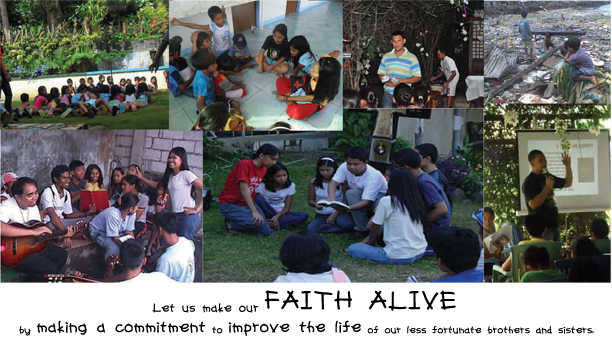
Our Gospel reminds us to include in our plight the concern for the poor.  It is not enough to say I have not done any harm or violence to other people. In the letter of James (2:16-18) he mentioned “If one of you says to them, “Go in peace; keep warm and well fed,” but does nothing about their physical needs, what good is it? In the same way, faith by itself, if it is not accompanied by action, is dead. But someone will say, “You have faith; I have deeds.” Show me your faith without deeds, and I will show you my faith by my deeds. I really admire the Pondo ng Pinoy campaign of the Archdiocese of Manila because is not only about the little charity that we share to other people, but it is also a way of forming the faithful to make the plight of poor as part of our everyday life. Let us make our FAITH ALIVE by making a commitment to improve the life of our less fortunate brothers and sisters.  MANGYARI NAWA.